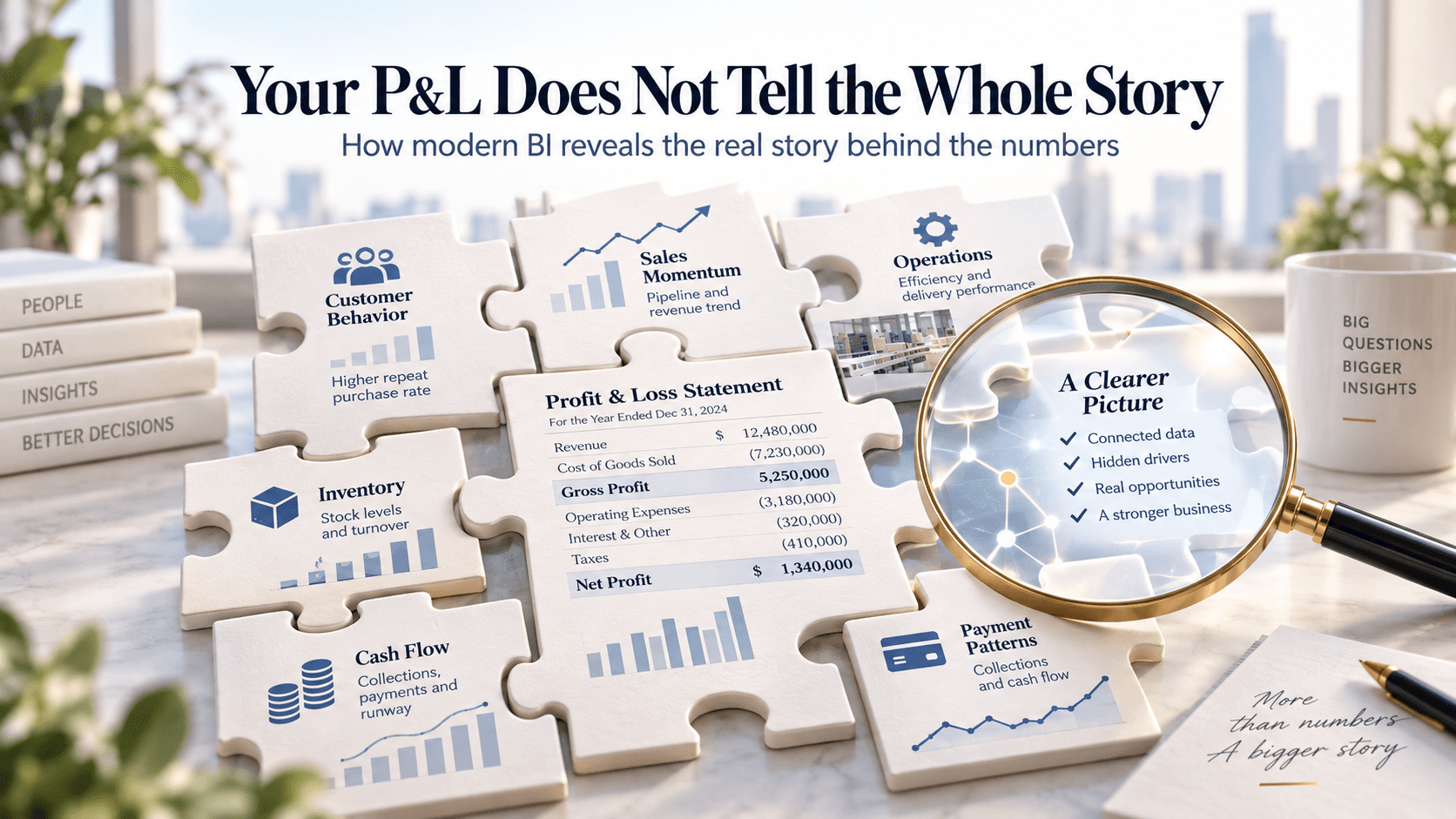
A company can have its best financial year and still be moving in the wrong direction. Revenue may be growing, profit may be improving and margins may remain healthy while repeat customers buy less often, discounts become more aggressive, delivery times increase or a larger share of revenue becomes dependent on a few major accounts.
Nothing about the financial statements is necessarily wrong in that situation. They are reporting the economic result of the period, while many of the conditions that will shape the next period may already be changing somewhere else in the business.
That difference matters because strong financial performance can create a false sense of security when management looks only at the outcome. The more useful question is not just whether the company produced a good result, but whether the business that produced it is becoming stronger.
Two Similar P&Ls Can Tell Very Different Stories
Imagine two companies that both increased revenue by 15 percent this year and improved profit by roughly the same amount. On paper, both appear to have had a strong year, and nothing in the headline financial numbers immediately suggests that one may be in a healthier position than the other.
The first company reached that growth because existing customers are returning more often, new customers are being added steadily and no single account has become unusually dominant. Its sales pipeline remains healthy, while operations have absorbed the additional volume without a noticeable deterioration in service.
The second company reached the same growth through a very different path. One large customer contributed most of the increase, deeper discounts were needed to maintain sales volume, several long-standing customers are purchasing less frequently and the pipeline entering the next quarter is weaker than it was a year earlier.
The reported growth is real in both cases, but the quality of that growth is not the same. One business appears to be strengthening the conditions that support future performance, while the other may be producing a good financial period by leaning more heavily on conditions that are becoming less reliable.
The Financial Result Is the End of the Story, Not the Beginning
Most financial measures are outcomes of activity that happened earlier. Revenue, margin and profit matter enormously, but by the time they change, the customer behavior, operational pressure or commercial weakness behind that movement may have been developing for weeks or months.
A customer rarely disappears on the same day revenue falls. Purchase frequency may decline first, certain products may disappear from the basket, service interactions may increase or payment behavior may gradually move from 25 days to 35 and then 45 while the account still looks acceptable in a conventional report.
The same pattern appears in operations. Inventory does not suddenly become a problem when an item reaches zero, because demand may already be accelerating while supplier lead times increase and replenishment performance deteriorates long before the shortage becomes visible.
This is where management gains a much better view of the business by looking beyond the final number. The financial result remains essential, but it becomes more meaningful when the company can see the behavior that created it and how that behavior is changing.
Growth Has Quality, Not Just Size
Revenue growth is one of the easiest numbers to celebrate because it looks simple and decisive. A company grew by 10, 15 or 20 percent, so the natural assumption is that the business became stronger.
The source of that growth, however, can completely change what the number means. Revenue may increase because the company added customers, improved retention, increased purchase frequency or sold more products to existing accounts, but the same growth could also come from price increases, one exceptional contract, aggressive discounting or growing dependence on a handful of customers.
Both situations produce growth, yet they do not create the same future. That is why management needs to understand not only how much revenue changed, but what actually moved it and whether those drivers appear repeatable.
Margin deserves the same treatment because a stable percentage can hide very different economics underneath. Strong pricing and cost control may be protecting profitability, or heavier discounting may be getting temporarily offset by a favorable product mix elsewhere in the business.
This is what makes the quality of growth more useful than the headline number alone. Once management understands where the result came from, it can begin judging whether the company is building something stronger or simply reporting something better.
The Future Often Appears First in Customer and Commercial Behavior
Customer behavior is one of the best places to look for early changes because relationships rarely strengthen or weaken all at once. A customer may continue buying while ordering less frequently, reducing basket size, dropping profitable categories or becoming increasingly sensitive to price, and none of those changes has to create an immediate decline in reported revenue.
The sales pipeline can reveal something similar about future commercial momentum. Current revenue may still look excellent while fewer qualified opportunities are entering, conversion slows or the pipeline becomes concentrated around a few unusually large deals, which means today’s result can remain strong even while tomorrow’s opportunity base is becoming weaker.
These signals are not predictions in the dramatic sense, and they do not need to be treated as such. Their value comes from showing that something important is moving before the movement reaches the final financial outcome.
A business that sees those changes early gains time to investigate and decide whether action is needed. A business that waits for the P&L to confirm the problem often begins the conversation after many of its best options have already disappeared.
Operations Can Be Weakening While the Numbers Still Look Good
Strong sales can hide operational weakness for surprisingly long periods because organizations are very good at compensating in the short term. Employees work harder, managers solve more exceptions, customers accept occasional delays and the company continues delivering enough to protect the financial result.
Eventually, that pressure begins to appear elsewhere through longer fulfillment times, weaker product availability, more returns, growing service backlogs or increasing workload on key people. The financial impact may come later, but the business was already showing signs of weakness much earlier.
This is why operational performance belongs in the same conversation as financial performance. Measures such as delivery reliability, inventory availability, service delays, return rates or capacity pressure can help management understand whether current growth is being supported by a stronger operating model or simply by asking more from the existing one.
The purpose is not to turn every operational measure into an executive KPI. The purpose is to identify the few conditions that genuinely matter to the company’s ability to continue producing the financial results management cares about.
The Best KPIs Are Built Around the Business Model
There is no universal set of KPIs that can tell every company whether it is healthy. A retailer may depend heavily on repeat purchases, basket size and stock availability, while a distributor may care more about order frequency, payment behavior, customer concentration and inventory movement.
That means KPI design should start with the business model rather than with a generic dashboard template. Management should ask which conditions need to remain healthy for this particular company to keep creating value, then choose measures that show whether those conditions are strengthening or weakening.
This creates a much more useful performance system because the KPIs are connected directly to the way the business works. If repeat customers are essential, purchase frequency and retention deserve attention; if growth depends on the pipeline, opportunity quality and conversion become important; and if customer service is part of the competitive advantage, delivery and service performance belong in the picture as well.
The goal is not to collect more metrics, because more numbers can easily create more noise. The goal is to identify the signals that explain the financial result and give management enough context to understand whether that result is likely to remain healthy.
Modern BI Makes the Real Performance Drivers Visible
For many companies, the difficulty was never knowing that these factors mattered. The difficulty was that Finance had the P&L, Sales had the pipeline, Operations had fulfillment data, Customer Service had complaints and Credit Control had payment history, so management often received the pieces separately and at different times.
Modern BI makes it possible to connect those signals around the same customers, products, branches, transactions and periods. Revenue growth can be viewed beside repeat purchasing and customer concentration, margin beside pricing and discount behavior, receivables beside changes in payment patterns, and current sales beside pipeline quality and operational capacity.
That changes the role of BI because it moves beyond reporting the final KPI and begins explaining the conditions behind it. Instead of simply telling management that revenue increased, the system can show where that increase came from, whether the customer base behind it is strengthening and whether the operating environment can continue supporting it.
This is also where BI becomes more useful for looking forward without pretending to predict the future perfectly. When management can see important business drivers changing before those changes reach the financial statements, it gains an earlier and more realistic view of where performance may be heading.
Financial Results Should Be the Outcome, Not the Entire Performance System
Financial statements remain essential because every successful strategy eventually has to create revenue, margin, cash and return. Their limitation is not that they are inaccurate, but that they show only one layer of a much larger picture of business performance.
Today, modern BI tools and techniques give management the ability to assess and maintain the real drivers of success instead of simply taking the financial result for granted. Revenue growth can be connected to customer behavior, margin to pricing and product mix, receivables to payment patterns, and current sales to the strength of the pipeline and the operational capacity supporting them.
This creates a much stronger basis for judging performance because management can move beyond asking whether profit increased and begin understanding why it increased, which parts of the business created that improvement and whether those same conditions are continuing to strengthen. A strong P&L still tells us that the business performed well during the period, but understanding the drivers behind it helps answer the more important question of whether that success has a solid foundation for the periods ahead.