For many small and mid-sized businesses, the first reaction to AI is not excitement but concern about what it will demand from the company. Owners and executives start thinking about new infrastructure, unfamiliar systems, larger technical teams, ongoing operating costs, security questions, and the possibility that automation may eventually replace people who already understand the business.
That concern is understandable because major technology projects often used to work exactly that way. A serious new capability could require servers, network changes, software licenses, implementation work, maintenance, and specialized staff before the company had any real evidence that the investment would produce enough value to justify it.
The important point is that this is no longer the only way to move forward.
Modern technology has changed the economics of adoption, which means an SME can now prepare for AI without rebuilding the business around it.
Start With What Already Works
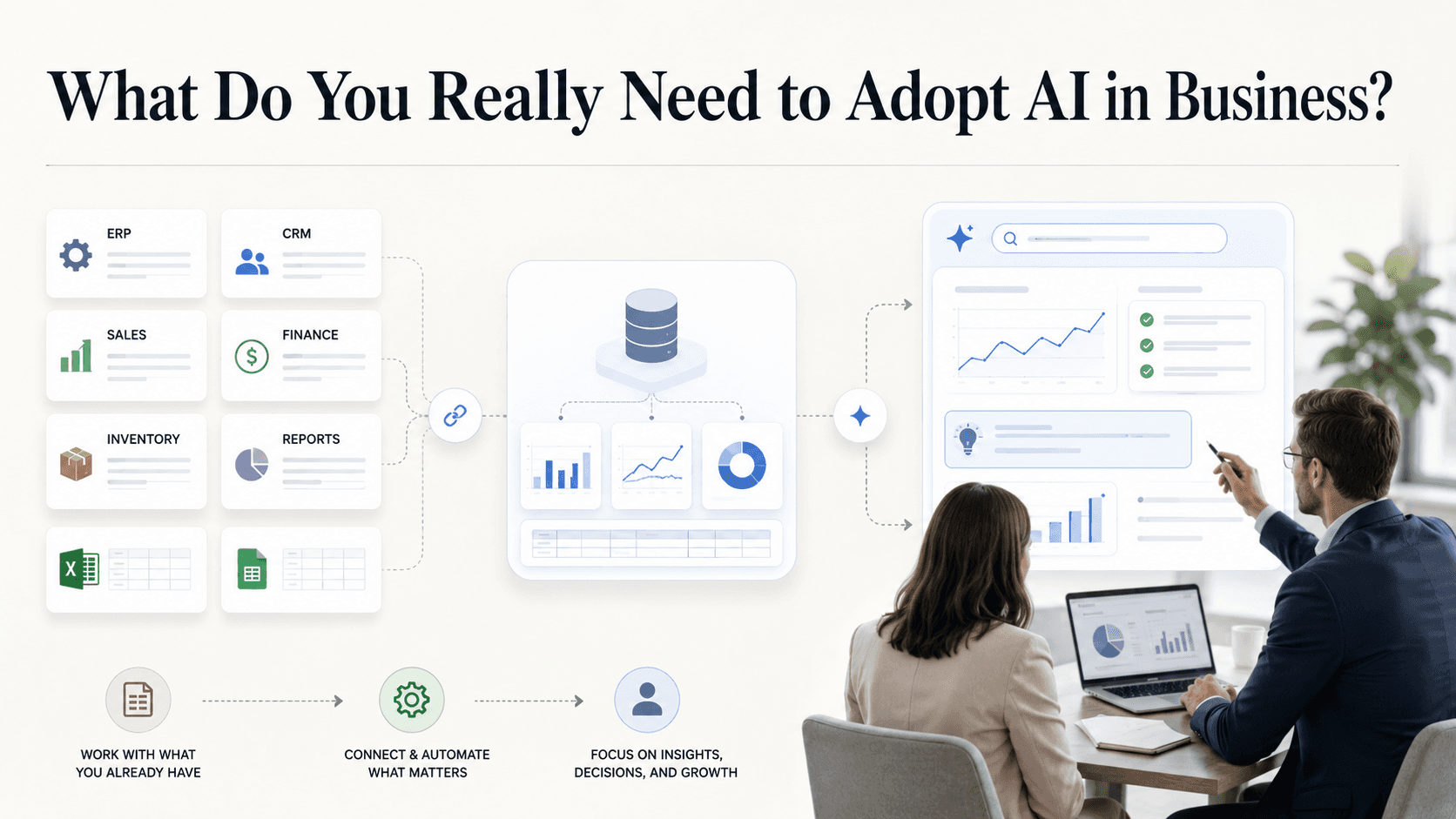
An ERP that supports the company today does not suddenly become useless because AI has arrived, and neither does an accounting system, CRM, SQL Server database, warehouse application, reporting platform, or even a collection of spreadsheets that still play an important operational role.
The better question is therefore not what should be replaced, but what already works well enough to keep and what needs to be connected around it.
APIs allow systems to exchange information in a controlled way, cloud services provide computing capacity without requiring the company to own all of the infrastructure underneath it, serverless platforms make it possible to add new applications without creating another traditional server environment to maintain, and automation tools can move information between systems without employees having to perform every step manually.
This creates a very different starting point from the traditional rip-and-replace project.
Instead of rebuilding the whole environment, the company can extend it.
A sales system can continue doing sales. Finance can continue using the accounting system it already trusts. Inventory can remain where it is. What changes is the ability to bring the important information together when the business needs a wider view.
That distinction matters because it lowers both the cost and the disruption of becoming AI-ready.
The Cost of Starting Has Fallen
One of the biggest changes in the technology landscape is that a company no longer needs to build the full infrastructure before testing whether an idea deserves to exist.
An SME can begin with one business problem that already consumes time, creates risk, or limits visibility.
Management reporting may take several days because employees are exporting data from different systems and combining it manually. Collections may depend on somebody checking overdue customers one by one. Sales and finance may each have a different view of the same customer. Employees may be copying information between applications every morning because the systems were never connected.
Any one of these can be a valid starting point.
The company can connect only the information required for that problem, automate the repetitive movement around it, make the result visible, and then measure whether the improvement is worth expanding.
If the value is clear, the solution grows.
If it is not, the company has learned without committing itself to a major transformation.
For a small or mid-sized business, this is a much healthier model than spending heavily at the beginning and hoping the value will appear later.
AI Does Not Have to Increase Operating Costs
The next concern is usually operational rather than financial.
Even if the initial project is affordable, will AI create another system that needs constant attention, more specialists, more maintenance, and more monthly cost?
It can, if it is implemented badly.
A collection of disconnected tools, duplicated data, weak integrations, unclear ownership, and AI agents operating without clear limits can become expensive very quickly. But that is not an argument against AI. It is an argument for disciplined implementation.
When the architecture is designed properly, the effect can move in the opposite direction.
Managed services can reduce the amount of infrastructure the company needs to maintain directly. Automation can eliminate repetitive operational tasks. Integration can reduce the need for employees to enter the same information in several places, reconcile differences manually, or spend hours preparing recurring reports.
Imagine a monthly management report that currently requires several people to export files, combine figures, fix inconsistencies, refresh charts, and distribute the final version.
Automating that flow already creates value before AI does anything advanced.
If AI is then added to explain unusual changes, summarize risks, highlight opportunities, or help management ask follow-up questions, it is being added on top of a process that has already become more efficient.
In that situation, AI is not simply another cost center. It becomes part of a broader effort to reduce operational friction.
The Immediate Opportunity Is Better Use of People
The employee question is where the conversation around AI often becomes unnecessarily dramatic.
For many SMEs, the best first use of automation and AI is not replacing employees. It is stopping the business from wasting capable employees on work that does not require their full ability.
A finance employee may spend hours assembling information that could have been collected automatically. A salesperson may search three systems before speaking to a customer. An analyst may rebuild the same report every Monday even though the logic has not changed. A support employee may spend part of the day classifying requests before doing the work that actually needs judgment.
These tasks may be necessary to the process, but that does not mean every step needs to remain manual.
When finance spends less time copying and reconciling data, more attention can go toward cash flow, risk, and exceptions. When sales spends less time searching for information, more time can go toward customers. When analysts stop rebuilding repetitive reports, they can spend more time understanding why something changed and what management should do next.
That is a much more useful way to think about AI adoption.
The objective is not to remove human value from the business, but to move human capability toward the parts of the business where it matters most.
And human judgment still remains central.
AI can identify patterns, summarize information, suggest actions, and even perform controlled tasks, but business context, responsibility, relationships, exceptions, negotiation, and final decisions still require people who understand what the numbers actually mean.
Good AI implementation should therefore make people more effective, not make them irrelevant.
Readiness Comes Before Intelligence
This is where many companies misunderstand what AI readiness actually means.
A business does not become AI-ready because it subscribes to an AI model.
It becomes ready when the information the business depends on can be reached, trusted, connected, and used consistently enough for AI to work with it.
Consider two similar companies.
Both have a sales system, an accounting system, inventory data, and spreadsheets. In the first company, each area sees only its own part of the picture. Sales may be celebrating a customer whose purchases are increasing rapidly, while finance is becoming concerned because the same customer is already 90 days overdue.
Neither department is wrong.
The problem is that the business is seeing two isolated truths instead of one connected situation.
If the systems remain disconnected, the company may continue increasing sales to a customer whose financial risk is becoming worse.
The second company does not necessarily replace any of those systems. It simply connects the important information so that sales activity and collection behavior can be understood together.
Management can now see that revenue is growing while payment behavior is deteriorating, and the company can react before the risk becomes larger.
AI becomes much more useful in the second company because it is working with a wider business context instead of isolated fragments.
The model may be exactly the same in both companies.
The business underneath it is not.
Automation Is What Makes the Foundation Reliable
Connecting systems is only part of the story because a connected environment still becomes fragile if employees have to move the information manually every day.
Automation is what turns the connection into a dependable operating flow.
Transactions can move automatically. Dashboards can refresh without somebody remembering to trigger them. Exceptions can create alerts. Customer information can be synchronized. Reports can be prepared on schedule, and routine processes can happen quietly in the background.
This improves efficiency, but it also improves the quality of the information available to management and AI because the flow no longer depends as heavily on manual intervention.
That is why automation should not be treated as a separate topic from AI readiness.
It is part of the foundation.
AI needs reliable context, and reliable context usually depends on information moving through the business in a consistent way.
AI Agents Need Responsibilities, Boundaries, and Human Review
Once the foundation is reliable, AI agents can begin taking responsibility for specific parts of a process.
The useful way to think about them is not as autonomous digital employees roaming through the company, but as tools with clear job descriptions.
A Collections Monitor could review overdue balances, detect changes in payment behavior, and prepare a prioritized list for the finance team. A Lead Enrichment Agent could review incoming leads, collect approved information, and help sales decide which opportunities deserve attention first. A Support Router could classify requests and direct them to the right department, while a Management Briefer could use trusted sales, finance, and inventory data to prepare a concise operational summary each morning.
What makes these agents useful is not only the intelligence of the model.
It is the clarity around what they are allowed to access, what they may do, where their responsibility ends, and when a human must review or approve the result.
That is how AI moves from an impressive demonstration into something a business can actually trust.
Start With One Problem and Build Readiness From There
The mistake many SMEs should avoid is turning AI readiness into another large transformation program.
A company does not need to produce a three-year AI roadmap before solving the first useful problem.
It needs to start somewhere real.
Connect the information required for one business problem, organize it into something management trusts, automate the repetitive movement around it, make the result visible, and then introduce AI where it adds value through analysis, interaction, or controlled action.
The progression can be thought of simply as:
Connect → Organize → Automate → Visualize → Ask → Act
The point is not to complete all six stages as quickly as possible. The point is that every stage makes the next one easier and less risky.
The first project may only automate a management report, improve collections visibility, connect customer information, or reduce manual work in one process, but it also teaches the company where its important data lives, how its systems can communicate, which information management trusts, where automation works well, and where human judgment must remain.
That experience becomes part of the business.
The second project becomes easier because the company is no longer starting from zero.
Then the third becomes easier again.
This is how readiness grows.
Waiting Is Not a Neutral Position Anymore
There is nothing wrong with being careful about AI, and companies should absolutely avoid chasing every new tool simply because the market is talking about it.
But there is a difference between caution and standing still.
While one company continues debating whether AI requires a major transformation, a competitor of similar size may already be automating one process, connecting one source of data, testing one AI use case, measuring what works, and learning what does not.
After several months, both companies may still have access to the same models and the same technology.
The difference is that one of them has already learned how to use those tools inside its own business.
That learning advantage matters because AI is moving quickly, and the next major improvement in models may become available to both companies at roughly the same time.
The company that already has connected data, automated flows, clear permissions, trusted information, and experience with human review can test that new capability immediately.
The company that has not prepared still has to discover where the data is, how the systems connect, which numbers are trusted, who owns the process, and where AI is allowed to act.
This is why readiness itself becomes a competitive advantage.
You Do Not Need to Rebuild. You Need to Be Ready.
Preparing for AI does not mean transforming an SME into a technology company, replacing every system that already works, building expensive infrastructure, or reducing the role of people in the business.
It means making the company easier to connect, easier to understand, easier to automate, and easier to improve.
Keep what works, connect what needs to communicate, automate the repetitive work that consumes human attention, give AI controlled access to trusted information, and keep people responsible for judgment, review, and decisions.
Then expand when the value becomes clear.
The AI race does not require every small or mid-sized business to make a huge investment tomorrow, but it does make continued unpreparedness increasingly risky because competitors are not only adopting technology, they are building experience.
The most important first step is therefore not to buy the most advanced model.
It is to make sure your business is ready to use the opportunity when it arrives.