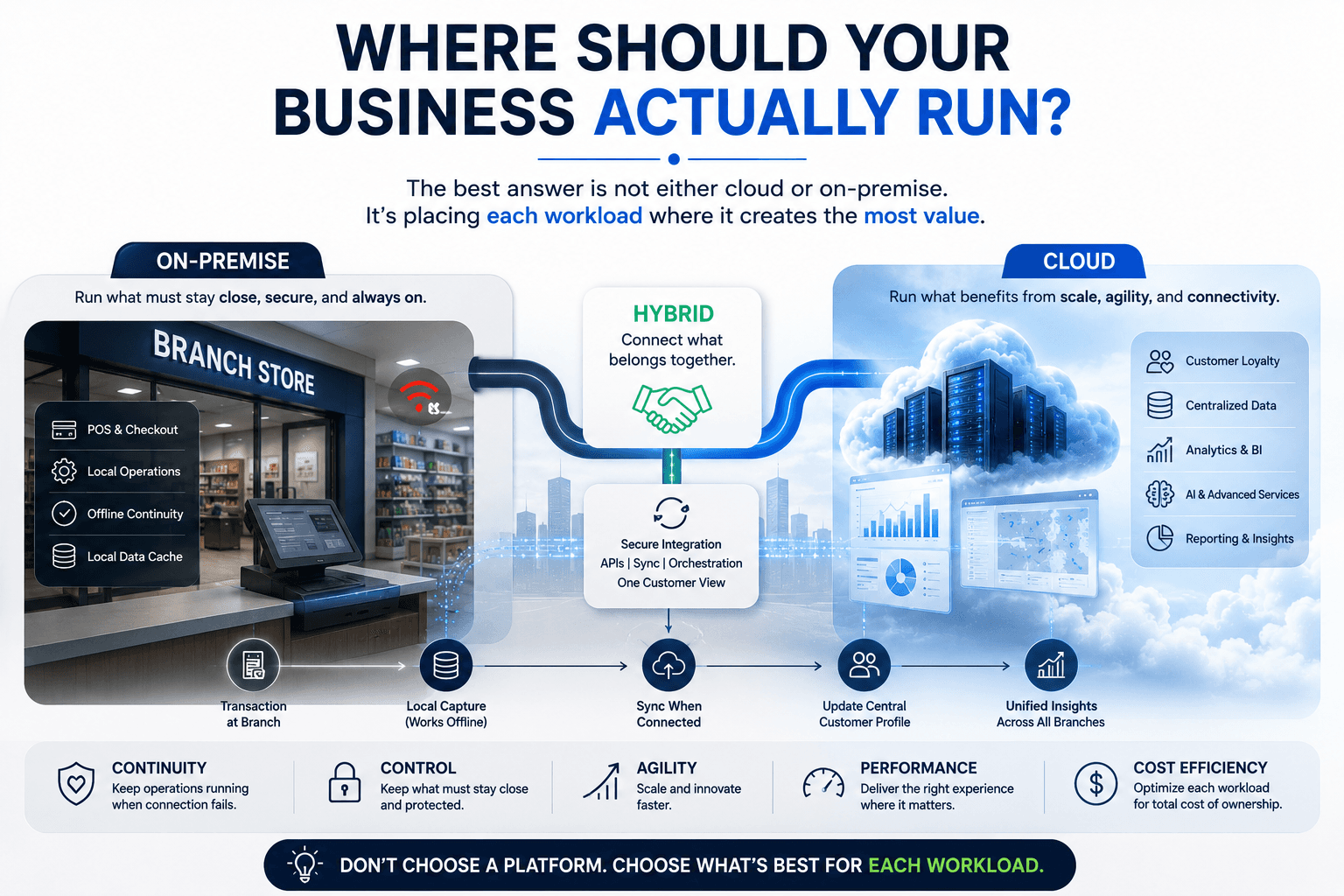
For years, infrastructure conversations were framed as a choice.
Cloud or on-premise?
Cloud promised scalability, faster deployment, easier access to new services, and less infrastructure to manage directly. On-premise offered control, predictable performance, local access, and greater authority over sensitive systems and data.
Both sides had valid arguments, but the problem was the question itself.
A business does not run one workload. It runs many, and those workloads rarely need the same things from the infrastructure around them. A point-of-sale system, a customer platform, an analytics environment, an AI workload, and a financial database may all belong to the same company while having completely different requirements for continuity, performance, control, connectivity, and cost.
That became particularly clear to me while working with a multi-branch retail customer.
The Loyalty Card Exposed the Real Infrastructure Problem
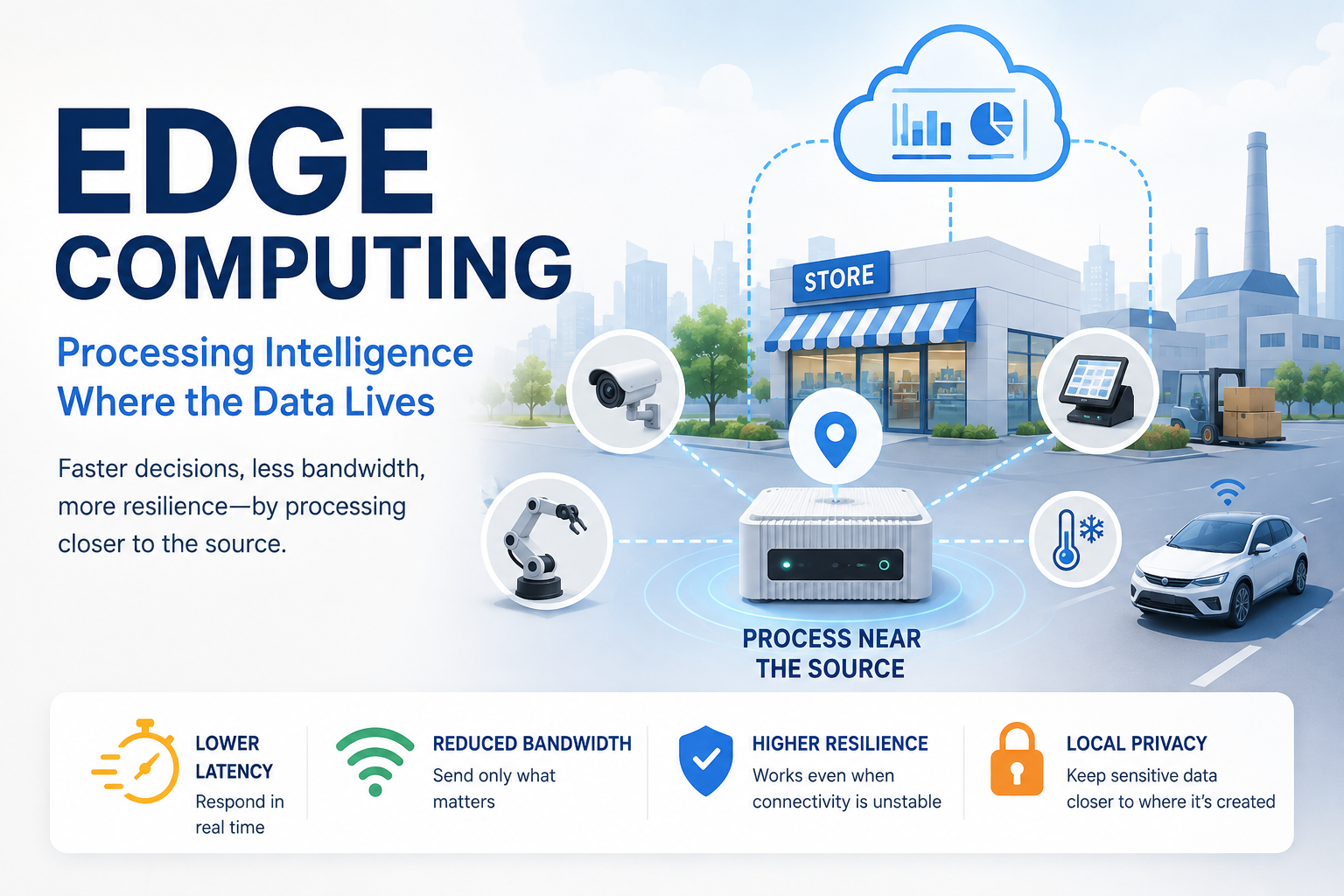
The customer operated several physical branches, and each store had to continue selling even when its connection to the central environment was interrupted.
That requirement alone made a completely centralized design difficult. A temporary internet problem should not stop a branch from serving customers.
The loyalty program created the opposite requirement.
A customer could shop at more than one branch, which meant loyalty points, customer information, promotions, and the wider relationship belonged to the business as a whole rather than to one individual store.
If everything remained isolated inside each branch, local operations would be resilient but the customer relationship would become fragmented. If everything depended entirely on the central environment, customer information would remain consistent but branch operations could become unnecessarily dependent on connectivity.
Neither extreme solved the actual business problem.
The useful answer was to separate the responsibilities. The branch needed enough local capability to continue operating, while the wider business needed central coordination so customer activity, loyalty information, reporting, and shared rules could come together across all locations.
Once you look at infrastructure this way, the old cloud-versus-on-premise discussion becomes much less useful.
The better question becomes:
What needs to run where, and why?
Local Execution, Central Coordination
The retail example works because the trade-off is easy to see.
Checkout is operational. If it stops, the business consequence is immediate, so enough of that capability should remain close to the branch to keep the store running.
The customer relationship is different. Loyalty balances, customer identity, consolidated activity, promotions, and company-wide reporting become more valuable when they are shared across locations.
That naturally leads to an architecture where some responsibilities remain local while others are coordinated centrally. Loyalty activity can continue during an interruption and synchronize later, branch operations remain available, and the wider business still maintains one view of the customer.
This is not hybrid infrastructure because someone decided that "hybrid" sounded like a sensible compromise.
It becomes hybrid because different workloads have different jobs to do.
That distinction changes the entire infrastructure conversation.
Start With the Workload, Not the Platform
Once infrastructure is viewed through the workload, technology selection becomes the second decision rather than the first.
For every important workload, I would start by asking what the business actually expects from it.
Continuity is one obvious question. What happens if connectivity disappears for an hour? A management report may tolerate a delay, while a branch checkout process probably cannot.
Coordination is another. Does the system serve one location, or does the information need to remain consistent across the company? Loyalty is a good example because the transaction happens in one branch while the relationship belongs to the entire business.
Control matters too. Some workloads may contain sensitive or regulated information, while others can operate comfortably through managed cloud services. The useful question is not whether cloud or on-premise is universally more secure, but which controls the workload requires and where those controls can be implemented effectively.
Performance introduces another consideration. Some systems benefit from remaining close to users, equipment, or local operations, while others gain more value from centralized capacity, broader connectivity, or elastic processing.
Then there is change itself. A stable operational system that has run predictably for years has a very different infrastructure profile from an AI service, analytical workload, or customer-facing application whose capabilities and demand may change quickly.
By the time these questions are answered, the appropriate placement often becomes much clearer.
Hybrid Is a Result, Not a Strategy
There is an important difference between having a hybrid environment and having a hybrid strategy.
Many companies already operate systems in several places. Some applications remain on-premise because they have always been there, others were moved to the cloud during a particular project, and newer systems may have been built somewhere else again.
Technically, that environment is hybrid.
Strategically, it may simply be accumulated infrastructure.
A deliberate infrastructure strategy should be able to explain why each important workload is where it is, what happens when connectivity fails, which system owns the authoritative version of the data, how synchronization works, where security controls are enforced, and what conditions would justify moving the workload somewhere else later.
If those answers are clear, the architecture is being managed deliberately.
If the answer is simply "that is where the system has always been," the company may have a hosting arrangement rather than an infrastructure strategy.
Cost Is Bigger Than the Server Invoice
The same problem appears when infrastructure decisions are reduced to cost.
Cloud is sometimes described as cheaper because the company avoids purchasing and maintaining infrastructure. On-premise is sometimes described as cheaper because a predictable workload can run for years on owned capacity.
Both statements can be true, but neither is enough to make the decision.
The real cost of a workload includes much more than compute and storage. It includes the people required to operate it, integration with surrounding systems, resilience, security, data movement, downtime, support, scaling, and the difficulty of changing the architecture later.
In the retail example, the cost of a branch losing the ability to sell matters. The cost of maintaining fragmented customer information across locations also matters.
Neither appears neatly on a server invoice.
This is why the objective should not be to find the cheapest platform in isolation. The better objective is to place the workload where the business can operate reliably and efficiently when all of those consequences are considered together.
Infrastructure Starts to Look Like a Portfolio
Once workloads are evaluated individually, infrastructure strategy begins to resemble portfolio management.
Not every workload deserves the same treatment because not every workload creates value in the same way.
A branch operational system may remain local because continuity matters more than centralized execution. A customer platform may be centralized because the relationship crosses locations. Analytics may benefit from consolidated data and scalable processing, while AI workloads may need elastic capacity because demand can be irregular and access to managed models or services may matter more than owning the underlying infrastructure.
Financial systems, backups, archives, customer applications, integrations, operational databases, and analytical platforms may all lead to different answers.
The goal is not to make the architecture unnecessarily complicated. The business already contains workloads with different priorities, and a good infrastructure strategy simply acknowledges those differences instead of forcing everything into the same hosting decision.
AI Makes Workload Placement Even More Important
AI adds another reason to stop treating infrastructure as one company-wide choice.
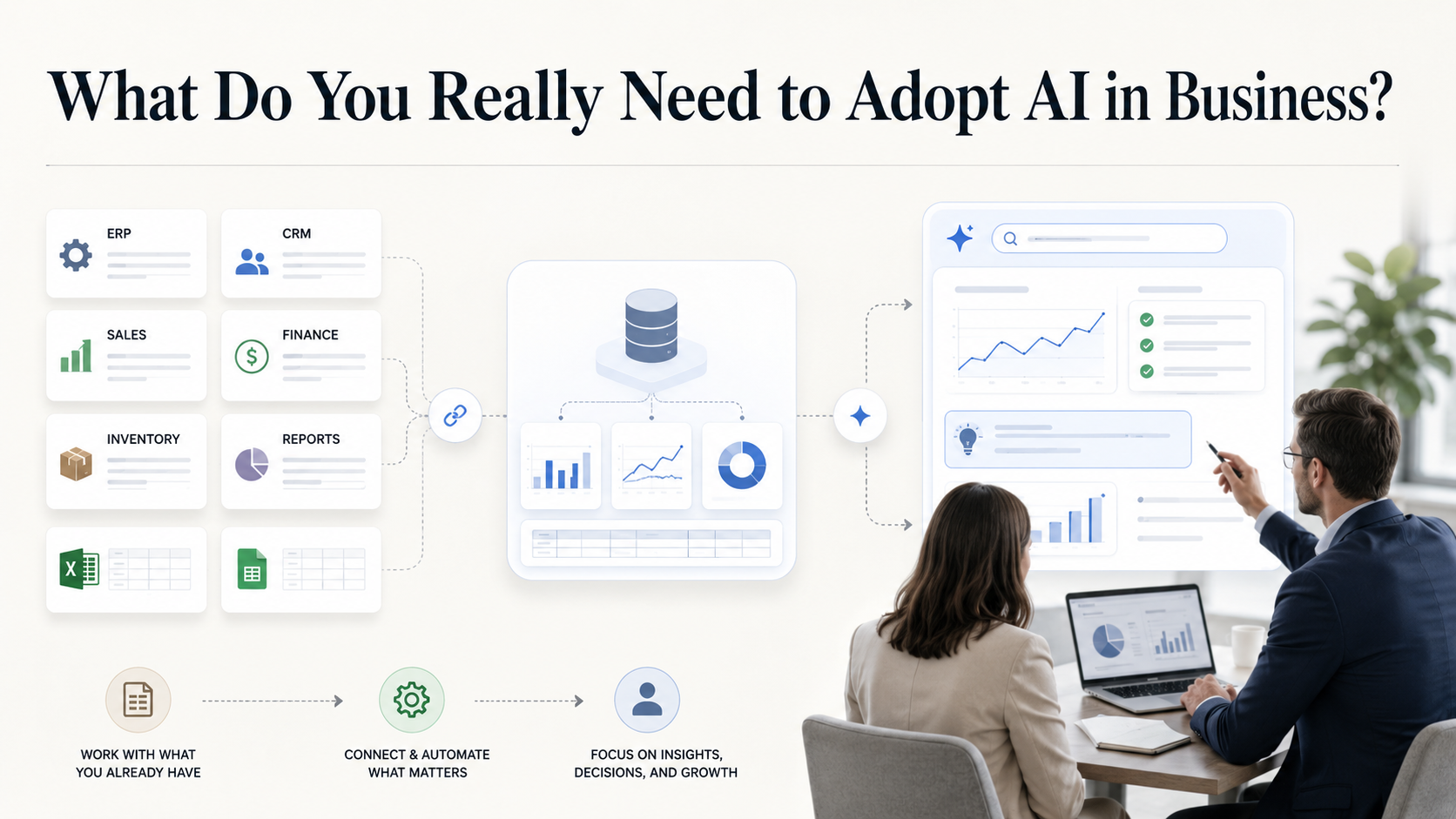
An AI workload can behave very differently from a traditional operational system. Model usage may rise sharply during certain periods, new capabilities may be introduced quickly, and the workload may depend on external models, vector databases, APIs, or specialized compute that would make little sense to build locally for occasional use.
At the same time, the data being used by AI may still live in systems that should remain on-premise for operational, regulatory, security, or performance reasons.
That does not mean the entire environment should move to the cloud just because the company wants AI.
It means the architecture needs to connect workloads intelligently.
The data may remain where it belongs, selected information may be exposed through controlled services or APIs, and the AI workload may run where elasticity and managed capabilities make more sense.
The principle remains exactly the same: place each responsibility where it best supports the business rather than moving everything simply because one new technology has entered the picture.
The Answer Can Change
Workload placement should not be treated as permanent.
A system that made sense on-premise five years ago may now benefit from cloud services because the way the business uses it has changed. A workload moved to the cloud during a period of rapid growth may later become stable enough that another model produces better economics or greater control.
Regulation can change the answer. So can acquisitions, new branches, new products, improved connectivity, AI adoption, changing usage patterns, or simply the cost of keeping a workload where it currently sits.
Infrastructure strategy therefore should not end after a migration.
Major workloads should occasionally be reconsidered against the needs of the business, because the architecture that was right for yesterday's operating model may not be the right one for tomorrow's.
The Better Infrastructure Question
If I were entering the cloud-versus-on-premise discussion today, I would not begin by choosing between them.
I would map the important workloads first and understand what the business expects from each one.
Which functions cannot stop when connectivity disappears? Which information must remain consistent across locations? Which workloads require tighter control? Which benefit from elasticity? Which depend on low latency? Which change frequently? Which have become unnecessarily expensive or difficult to operate where they are today?
My retail customer did not really have a cloud problem or an on-premise problem.
The business had branch operations that needed local resilience and a customer relationship that needed central coordination. Once those responsibilities were understood, the infrastructure decision became much easier to explain.
That is the shift that matters.
Do not decide where the company should run. Decide where each workload can best support the business.