Pricing often looks simpler than it really is. A company calculates the cost of a product, adds the required margin, approves a selling price, and records that number in its ERP. The price may then remain untouched for weeks or months, even though the conditions that justified it are already changing.
Supplier costs rise, freight becomes more expensive, inventory starts building up, demand slows, or customers begin reacting differently. None of those changes automatically updates the price stored in the system, which means a price can gradually become less appropriate while still looking perfectly normal.
Dynamic pricing starts from a simple idea: the price should remain connected to the conditions behind it.
A Fixed Price Can Quietly Become the Wrong Price
Suppose a distributor sells a product for $100 when its cost is $70. Demand is stable, stock is moving normally, and the margin is healthy, so the price makes sense.
A few months later, the supplier increases the cost, freight becomes more expensive, and the business is now paying $76 for the same product. The selling price is still $100 because nobody has reviewed it yet, but the economics have already changed. Every sale is producing less margin than originally expected, and if the product sells in large quantities, the financial effect can become significant before it appears clearly in a monthly report.
This is the main weakness of static pricing. The price list records a decision, but it cannot tell whether the assumptions behind that decision are still true.
Dynamic pricing does not mean that the price must change every day. It means the business should know when the current price deserves another look.
The Right Price Depends on More Than Cost
Cost and margin are obvious parts of pricing, but they are only part of the decision. Demand affects how much customers are willing to buy, inventory affects how expensive it is to wait, and customer behavior tells us whether the current price is still being accepted.
Imagine a product that costs $50 and sells for $75. The margin looks healthy, but the warehouse contains nine months of stock and sales have been falling for six weeks. Keeping the price at $75 may protect the margin on each unit while leaving a large amount of cash tied up in inventory.
Now consider the opposite situation. Stock is becoming limited, demand is rising, and customers continue buying without noticeable resistance. The same $75 price now sits inside a very different business situation.
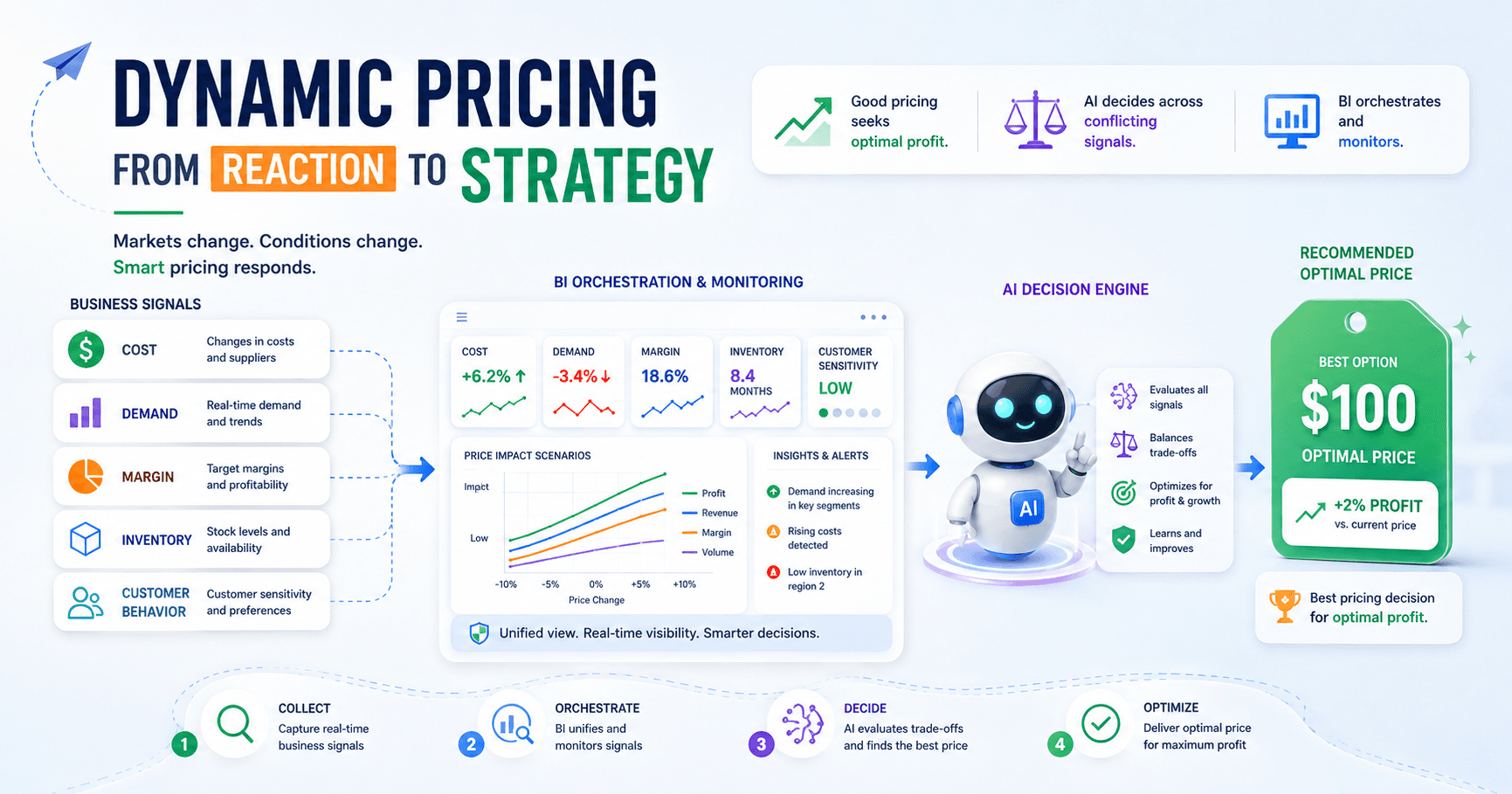
This is why smarter pricing needs a combined view of cost, demand, margin, inventory, and customer behavior. Looking at one variable alone rarely tells the full story.
BI Gives Pricing the Context It Is Usually Missing
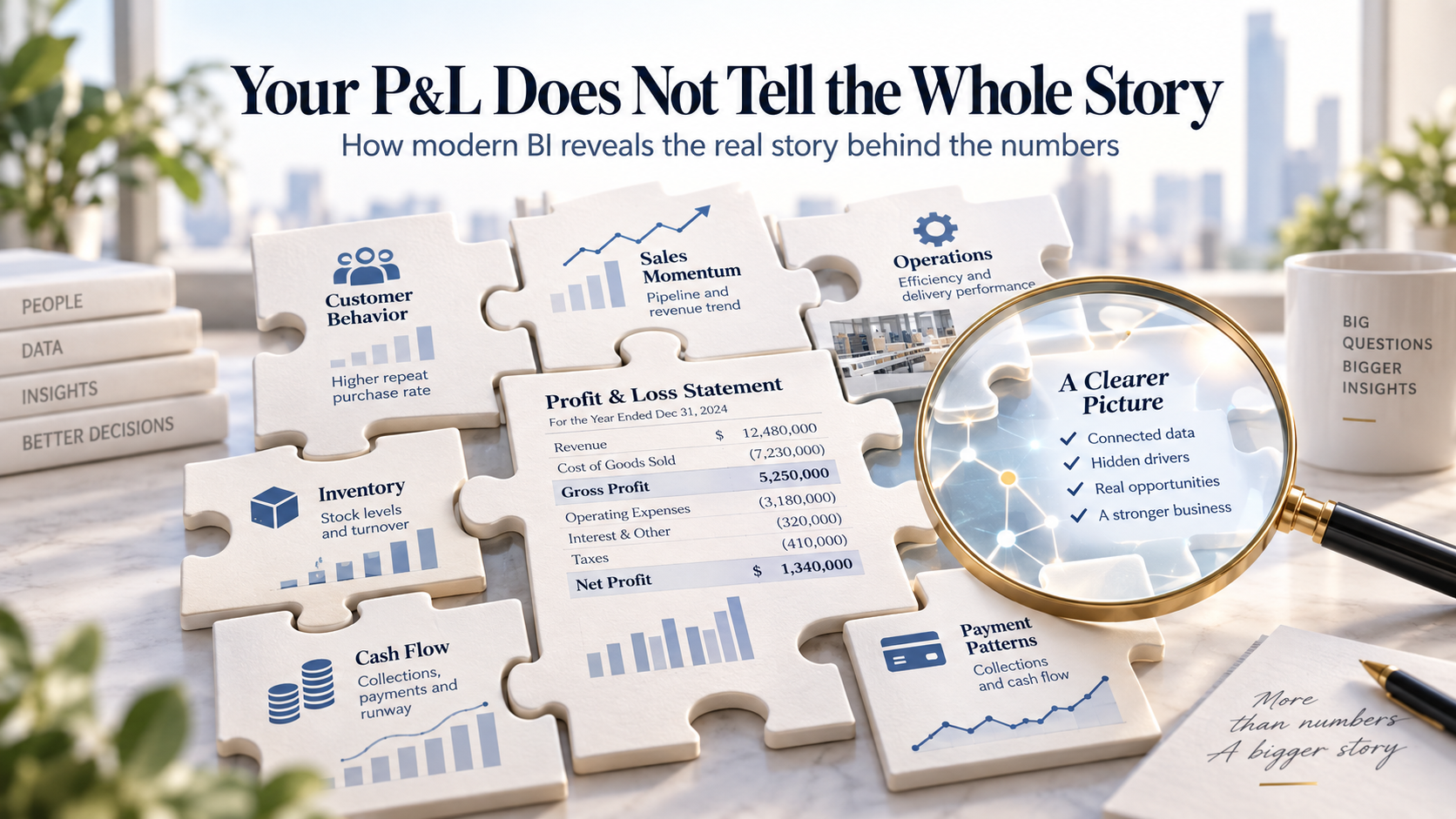
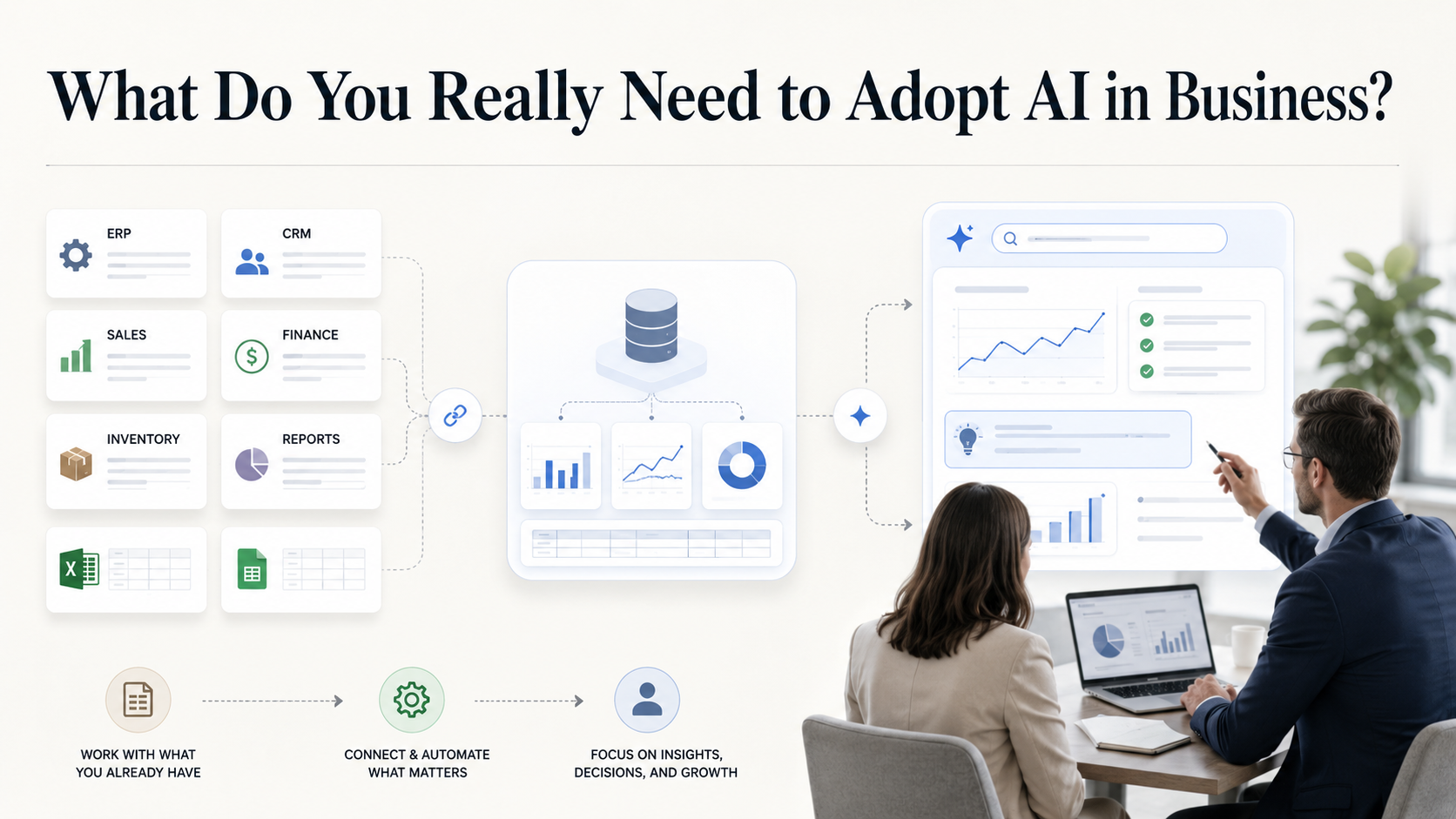
Most companies already have much of the information needed for better pricing, but it often lives in separate places. Finance sees cost, sales sees volume and discounts, operations sees inventory, while customer history shows changes in purchasing behavior.
Business Intelligence brings those signals together.
Instead of asking a broad question such as "Should we increase the price?", management can work with something more specific: cost has risen by 5%, demand remains stable, inventory is within its normal range, and customer order volume has not materially changed, so what would happen if the price increased by 2%?
That change in the conversation matters. Pricing moves from a judgment based on one or two numbers to a decision supported by the wider business picture.
AI Agents Can Make the Process Continuous
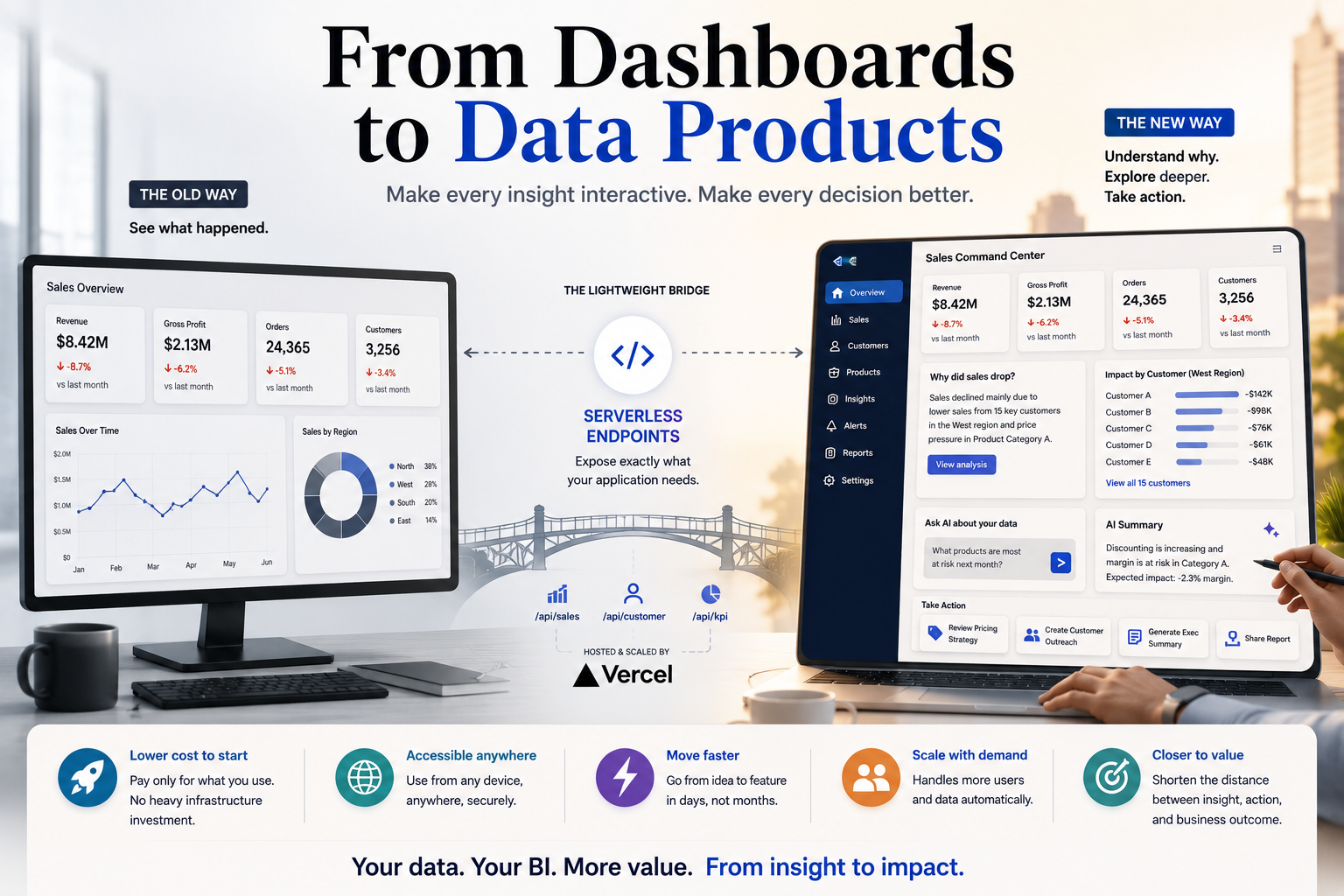
A dashboard gives management visibility, but it still depends on somebody opening it, noticing the problem, and deciding what to investigate.
An AI agent can work differently because it can continuously watch the variables behind pricing and identify when something has changed enough to deserve attention.
For example, an agent could monitor supplier cost, gross margin, inventory coverage, demand trends, discount behavior, and customer purchasing patterns. If supplier cost rises by 6%, margin falls below the company's target, and demand remains stable, the agent could prepare a pricing case instead of simply sending an alert.
That case might explain what changed, how much margin is being lost at the current price, which products or customers are affected, and what pricing options should be considered.
The agent does not need to become the pricing manager. Its value is in reducing the time between something changing in the business and someone understanding what that change means.
From Detecting a Problem to Testing the Response
Recognizing that a price may need to change is only the first step. The harder question is what happens after the change.
Suppose a company sells 10,000 units of a product at $20 and is considering moving the price to $21. Looking only at the extra dollar suggests higher revenue, but that assumes customers continue buying exactly the same quantity.
A better approach is to test several scenarios. What happens if volume stays the same? What if it falls by 3%? What if it falls by 8%? How does each case affect revenue, gross margin, and inventory movement?
BI provides the data needed for that analysis, while an AI agent can make the process much faster by running the scenarios automatically whenever an important pricing signal appears.
Instead of telling management only that "margin is falling," the agent could present the decision in a more useful form:
At the current price, expected monthly margin will continue to decline. A 2% price increase remains financially attractive if sales volume falls by less than 5%. Beyond that point, the benefit begins to disappear.
The numbers will differ from one business to another, but the principle is the same. The purpose is not to predict the future perfectly. It is to make the assumptions and trade-offs visible before the price changes.
Inventory and Customer Behavior Change the Answer
Pricing becomes even more useful when the model understands that the same margin does not always mean the same thing.
Two products may have identical cost, selling price, and margin, yet one has ten days of inventory while the other has enough stock for eight months. Protecting the margin on the first may make sense because supply is tight, while the second may need a different approach because holding the price could keep cash trapped in slow-moving inventory.
Customer behavior adds another layer. A small price increase may have almost no effect on one customer group while causing another to reduce volume or move to a competitor. Connecting pricing history with order frequency, quantity, discounting, and purchasing patterns helps the business see those differences instead of relying on averages.
An AI agent can bring these signals together, but the decision still needs business context.
AI Agents Still Need Clear Boundaries
More responsive pricing should not mean uncontrolled pricing.
Some customers have contracts. Some products have minimum-margin requirements. Strategic accounts may require approval before any price change, while management may deliberately accept lower margins to clear inventory, protect an important relationship, or enter a new market.
A practical pricing agent should therefore work inside clear rules. It may be allowed to monitor conditions, calculate scenarios, recommend a price adjustment, and prepare the reasoning automatically, while the final action depends on the size and type of change.
A small adjustment within an approved range might be executed automatically. A larger change could be routed to the commercial manager with the analysis already prepared.
This keeps the speed of automation without removing the judgment that pricing often requires.
From Reaction to Strategy
The biggest improvement in dynamic pricing is not that prices change more often. It is that the business understands sooner when the current price no longer fits the conditions around it.
With static pricing, the problem may become visible only after margin has already been lost or inventory has already accumulated. With BI, the business can see those signals earlier. With AI agents, those signals can be monitored continuously, interpreted in context, tested through scenarios, and turned into a decision before somebody has to discover the problem manually.
That is the move from reaction to strategy.
A strong pricing process should be able to explain why the current price still makes sense, what has changed since it was set, and what is likely to happen if the business changes it.
The price is only the final number. The real value lies in understanding when that number deserves another look, why it deserves attention, and what the business should consider before making the next move.