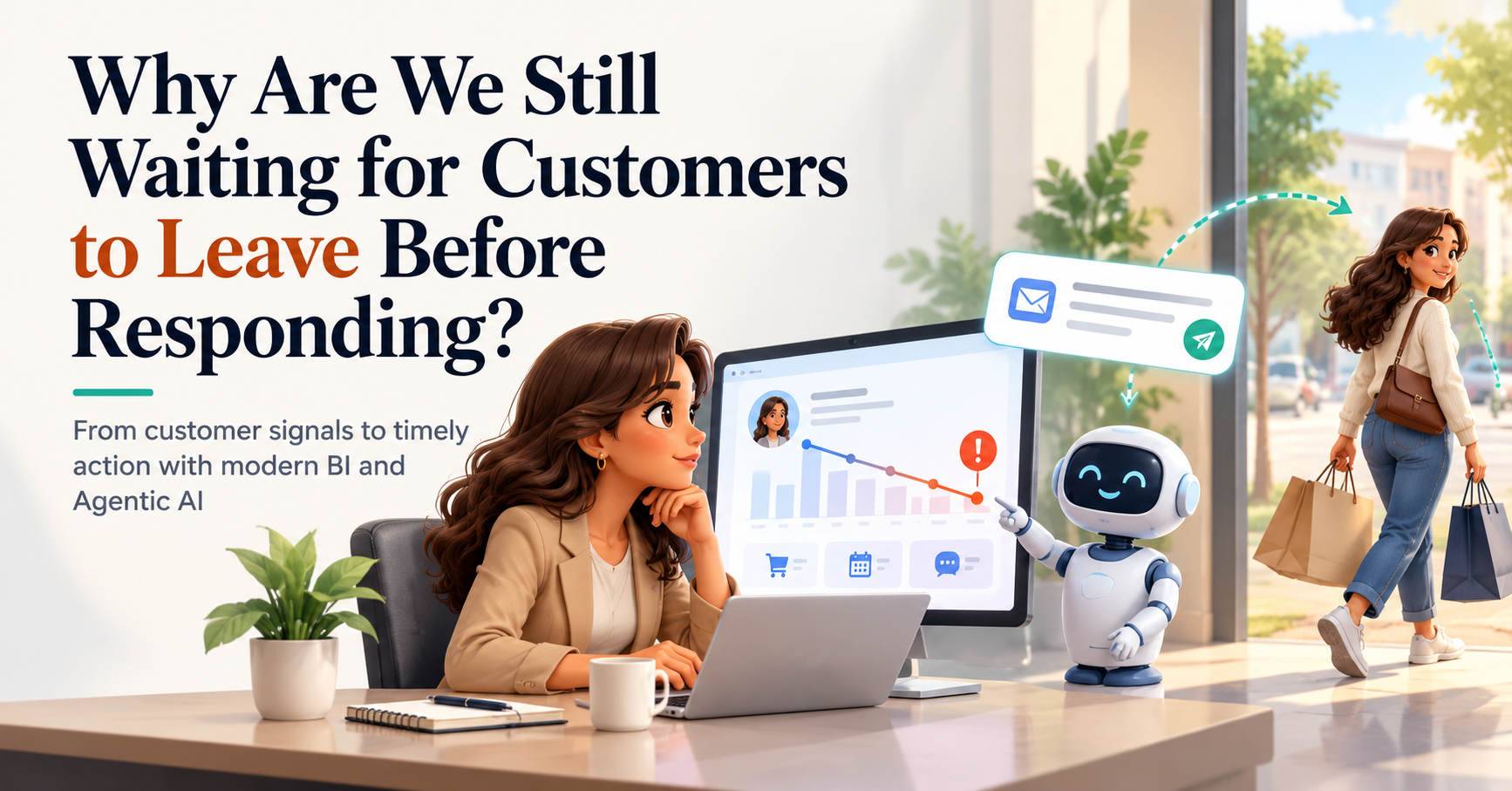
```text For most of my career around Business Intelligence, one of the main objectives was always to get information to the business faster. We moved from reports that arrived after the month was already closed to dashboards that could refresh throughout the day, and eventually many operational changes became visible almost as soon as they happened. From a technology perspective that was a major achievement, although if we follow what actually happens after an important number appears on the screen, we might get surprised by how much of the old delay is still there.
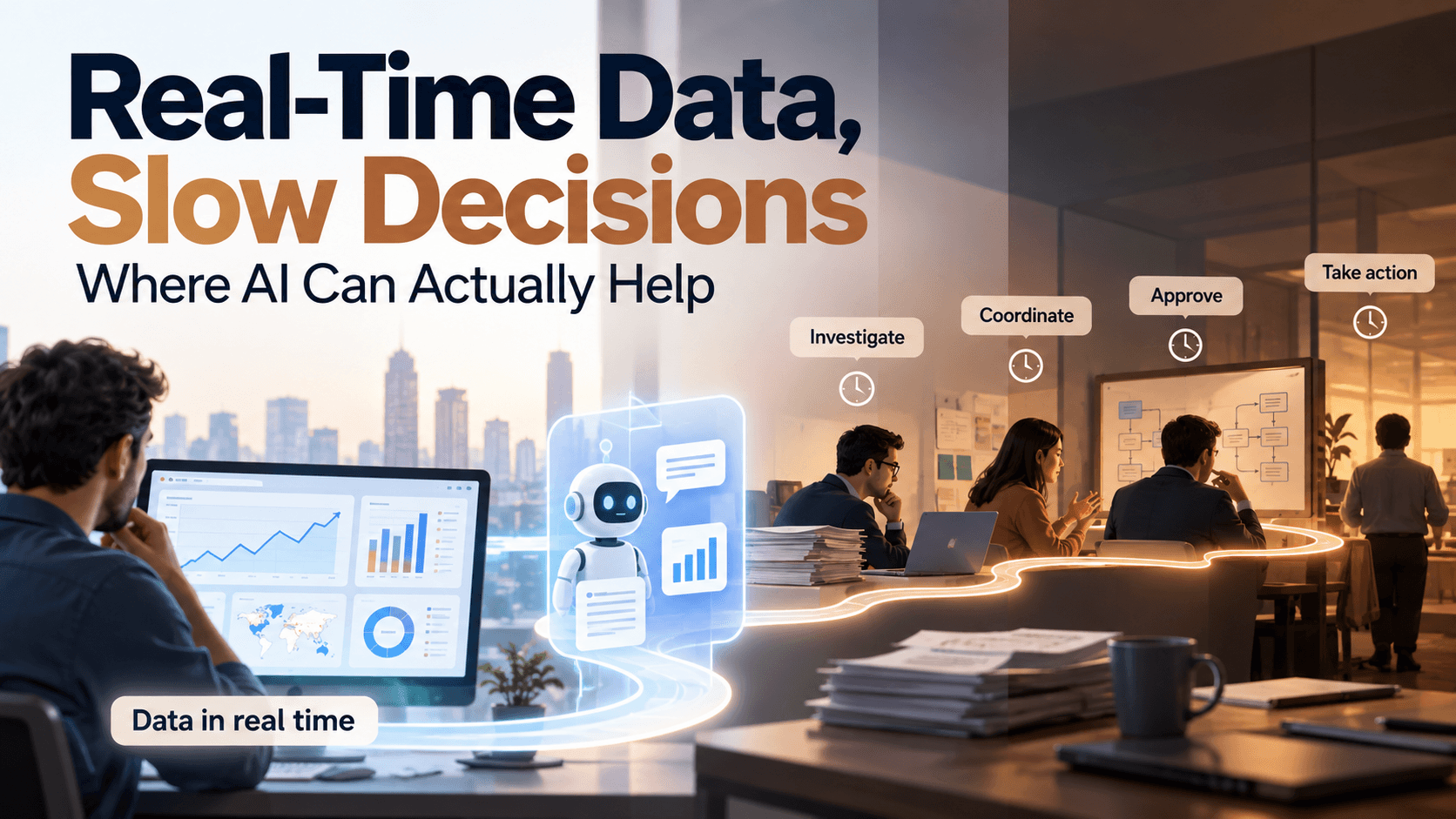
A problem can become visible this morning while the business does not really respond until tomorrow, because somebody still has to understand whether the change matters, investigate what caused it and involve the people who know the surrounding business context. Once that happens there may still be a decision to prepare, somebody may need to challenge it, and only after the organization becomes comfortable with the response does anything actually change in the real world. The information might have travelled from the transaction to the dashboard in seconds while the decision spends another day travelling through the company.
That gap is what I mean by decision latency, and I think it becomes particularly important when we start thinking seriously about what AI can do for business rather than only what it can do for individual productivity. We have invested for years in shortening the distance between an event and our knowledge of that event, yet the economic value is usually created somewhere later, when the business responds while there is still enough time for that response to influence the outcome. Once we look at the problem from that angle, making information real time begins to look like only the first half of making a business responsive.
A good decision can still arrive too late
Timing does not matter equally for every decision, and that distinction is important because I do not think the objective should ever be to make the whole company decide instantly. A major investment may deserve weeks of discussion because the debate itself improves the decision, while an important customer gradually changing its buying behavior can become a very different problem if the company notices it today rather than three months from now. In both situations we want good judgment, although the cost of waiting behaves very differently.
Consider a company that begins losing margin on a large customer relationship. If management discovers the reason after another quarter has passed, the analysis can still be perfectly accurate, but by then the commercial team may have accepted several more orders under the same conditions and the customer may have come to expect the new pricing level. If the same problem is understood while the pattern is still developing, management has options that may no longer exist later, which means the value of the decision is partly determined by when it becomes possible to act.
The same thing happens in much more operational situations. A maintenance team that understands an emerging equipment issue while production can still be moved to another line has more choices than the same team receiving a perfect diagnosis after the machine has already stopped. The important idea here is that information does not retain the same business value indefinitely, because the window in which the organization can influence the outcome is often shrinking while people are still investigating what happened.
This is why I would separate the quality of the answer from the usefulness of the decision. We naturally want both, but a highly accurate explanation that arrives after the available options have disappeared can create less value than a sufficiently reliable explanation delivered while management can still change what happens next. In my opinion, this is one of the places where AI can change the economics of analytics much more than simply saving somebody a few hours of work.
We solved a large part of the information problem while the decision process stayed familiar
If we looked at a fairly normal management situation, the remaining delay becomes easier to see. A dashboard shows that one region is suddenly underperforming, so the commercial manager asks the analyst to look deeper and the first analysis reveals that most of the decline is concentrated among a relatively small number of customers. Sales then brings context that was not visible in the numbers, which leads to another question about pricing or service history, and the discussion continues until everyone has enough of the picture to decide whether the change requires intervention.
There is nothing particularly wrong with this process because people are doing exactly what responsible management requires. What interests me is that almost all the technological improvement happened before this process began, since the data reached the dashboard faster and perhaps the first layer of analysis was already available, while most of the elapsed time remained inside the investigation and coordination that followed. We improved the speed of information much more aggressively than we improved the speed at which an organization can turn that information into a considered response.
This is where AI begins to change the discussion for me, because for the first time we have technology that can participate much more deeply in the space between seeing the signal and acting on it. I do not think the useful framing is that humans make decisions today and AI will make them tomorrow, because that reduces a much more interesting management problem into a debate about automation. The better question is how far AI should participate in each particular decision and what part of the delay it can remove without removing the judgment that still contributes real value.
The audio idea around the three modes of Decision Intelligence becomes useful exactly here. In some situations AI mainly helps the decision maker understand the issue, while in others it can move further and prepare much of what is needed before action. There are also situations where the company has already defined the normal response clearly enough that the system can execute within those boundaries, although I would never treat those modes as a ladder where every decision is supposed to end up fully automated.
When AI helps us reach the real decision sooner
Imagine a B2B company where the profitability of an important customer has been deteriorating for several weeks. The dashboard can show the margin decline immediately, although management still needs to understand whether the customer negotiated different pricing, whether its purchasing pattern shifted toward lower-margin products or whether something changed on the cost side that has little to do with the commercial relationship. Until that context becomes clear, the number is interesting but the decision is not ready.
An analyst may begin with the customer history and notice that the product mix changed, which leads to another look at the discounts being applied. The commercial manager then remembers that a special arrangement was introduced several weeks earlier, while finance points out that one supplier cost has increased at the same time, so what appeared at first to be one margin problem turns into a much more nuanced commercial discussion. By the time everybody understands the real issue, the final management decision may take only a few minutes even though several people have already spent part of their day discovering what those few minutes should actually be about.
This is where the first mode becomes useful because AI can reduce the investigative distance between the signal and meaningful human judgment. Instead of simply showing management that margin declined, the system can bring the relevant history into the same context and help identify which changes deserve attention, while the manager still owns the decision because interpreting the commercial relationship requires experience that cannot be reduced to one metric. The value comes from allowing the human discussion to begin much closer to the point where judgment matters.
For higher-value decisions, this may remain the right mode even if AI becomes far more capable than it is today. I would not want a major customer relationship or a significant strategic investment to become autonomous simply because the system can analyse the information quickly, because part of the value comes from experienced people challenging assumptions and understanding consequences that may never appear cleanly in the data. AI can still create substantial value by removing the searching and assembling that currently consumes much of the time before those people can start thinking about the actual decision.
There is also a risk here that becomes more important as AI gets better at explaining things. Traditional bad reporting could give management the wrong number, while AI can potentially give the wrong number together with a highly convincing explanation that makes the conclusion feel more trustworthy than the underlying evidence deserves. This means good data definitions and business context become even more important once the system starts helping with reasoning, because the quality of the thinking can only be as strong as the foundation it is allowed to think from.
Sometimes the decision is already obvious while the preparation is what consumes the time
There is another kind of latency where understanding the situation is not really the difficult part. The organization broadly knows what should happen, yet action still waits because somebody has to assemble the context and prepare what the responsible person needs before the company can move. In practice, I suspect a surprising amount of operational decision latency sits in this space because the final decision can be very quick once everything around it is ready.
Collections provides a good example because the business problem is usually familiar. Imagine a customer that normally pays reliably but has started paying later while its outstanding exposure continues to grow, and finance can already see clearly that the payment pattern has changed. The account manager still needs to understand whether there is an unresolved service issue or whether something unusual is happening commercially, because contacting a long-term customer with the wrong tone can create a problem that did not previously exist.
Today, preparing for that conversation may require someone to review the ledger and then move into CRM notes before speaking with sales to understand recent activity. After that, the account manager may discover that there is an open complaint which explains part of the delay, and suddenly the right decision is very different from the one suggested by the aging report alone. The manager may need only five minutes to decide how the company should respond, although getting the right five-minute conversation ready can easily consume an hour across several people.
This is where the second mode becomes much more interesting because AI can prepare the decision rather than merely alert somebody that the problem exists. It can bring together the relevant account history and explain what has changed, while preparing the next action according to the company's policy and leaving the final judgment with the person responsible for the relationship. The important gain is no longer that somebody wrote a customer message faster, because the larger change is that the business became ready to make the decision much earlier.
Once we look at it that way, the economic value can become very different from the usual productivity calculation. If responding earlier prevents a manageable payment issue from becoming a serious exposure, the time saved while gathering information is almost beside the point. What mattered was that the organization moved while the situation was still easier to influence.
The operating model changes when ordinary cases stop waiting for somebody to confirm them
The third mode becomes relevant when the organization has decisions that occur often enough and are governed clearly enough that human approval adds very little under normal conditions. This is where I think the discussion becomes more about process design than about AI itself, because management has to decide where the boundaries are strong enough for the system to act and where the situation becomes unusual enough that somebody should take over.
Consider an industrial company where equipment performance is monitored continuously and the maintenance team already has established rules around common conditions. A machine begins showing a pattern that historically leads to a known component failure, although the situation is still comfortably inside a range where maintenance can be scheduled without disturbing production. Under the existing process, an alert may reach a planner who looks at recent maintenance history and checks whether the replacement part is available before arranging the work once the necessary approval is obtained.
Adding AI to that workflow could obviously make the planner faster, but the more useful question is whether every normal case still needs to wait for the planner in the first place. If the operating conditions are well understood and the company has already decided what should happen under those conditions, the process can be redesigned so the action moves forward within the boundaries management has approved, while unusual situations return to the maintenance team because something has moved outside normal expectations. In that model the system handles what the business already knows how to handle, while people spend their attention where uncertainty actually exists.
The human role therefore does not disappear so much as move to a different place. Experienced people become more involved in defining the operating boundaries and reviewing how the system behaves over time, while less of their day is spent repeatedly confirming decisions where the answer is already well understood. I think this is a much healthier way to discuss autonomy because the organization remains accountable for the decision design even when nobody approves every individual action.
The objective is to remove waiting that contributes nothing
Once we start discussing faster decisions, it is tempting to assume that every delay should disappear, although some decisions become better precisely because people spend time challenging them. A major investment can be analysed far more quickly with AI while management may still want several people to question the assumptions before capital is committed, since that deliberate friction can protect the company from becoming confidently wrong. The existence of latency does not automatically mean the process is badly designed.
For me, the more useful distinction is between latency that improves the decision and latency that simply reflects how the organization used to work. If waiting gives somebody time to bring experience that materially changes the outcome, it may deserve to remain, while waiting because information is copied between systems or because every normal case follows the same approval chain deserves much more scrutiny. This distinction keeps Decision Intelligence connected to business judgment rather than turning it into another race toward automation.
It also explains why the three modes should not be treated as stages of maturity. A sensitive commercial decision may always remain close to the human decision maker because the discussion itself creates value, while a more repetitive process can move much further because the company already understands what should happen when conditions remain normal. The management capability lies in understanding where judgment contributes something and where people are being asked to participate mainly because the process was designed around older limitations.
This is where Decision Intelligence starts looking like process reengineering
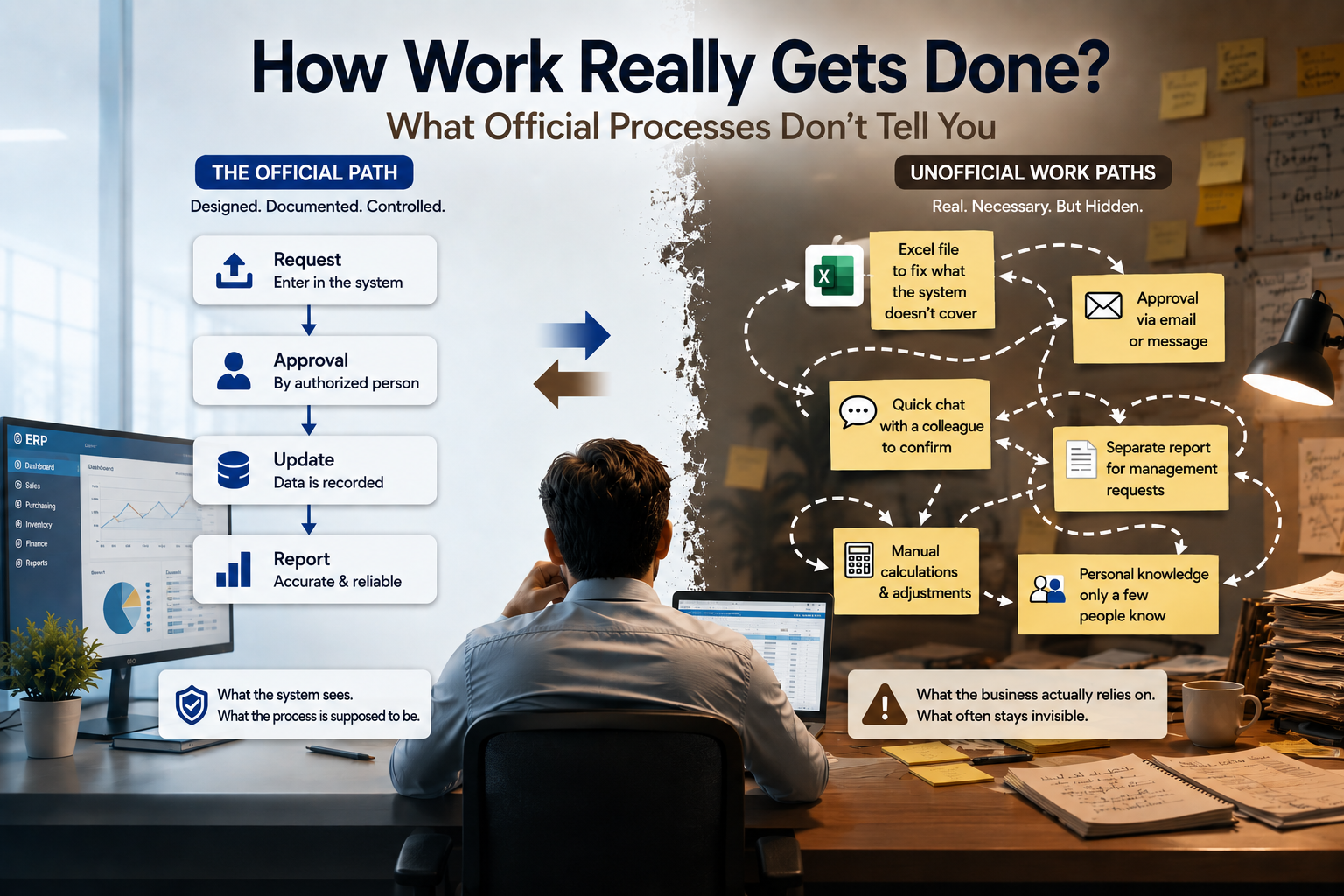
The more I think about this subject, the harder it becomes to separate Decision Intelligence from process reengineering because many workflows were built around limitations that made perfect sense when they were created. Reports existed because managers could not continuously inspect business activity themselves, while handoffs were necessary because important context lived in different parts of the organization. Approval structures also developed partly because systems could not reliably understand when a case was normal and when something unusual deserved management attention.
If those limitations change, improving every old activity with AI may not be enough. A company can generate the report faster and help the manager understand it faster, yet still wait for exactly the same weekly meeting before anybody decides what to do. At that point we have improved each step without questioning whether the process should still contain the same steps.
A weekly credit review gives us a simple example of how this can change. Finance and sales may traditionally meet to review a long list of accounts because looking at everyone was the only realistic way to make sure important problems were not missed. If the business can now continuously recognize which customer relationships have materially changed and assemble the surrounding context before anybody asks for it, the better design may not be an AI-assisted version of the same meeting.
Instead, the meeting itself can change purpose. Ordinary accounts no longer need to consume management time simply because they happen to be on the list, while the discussion can focus on the smaller number of situations where something important changed and the right response genuinely requires judgment. In this case AI does more than accelerate a task because it changes how management attention is allocated across the process.
That, in my opinion, is where some of the largest AI value will eventually appear. We will stop asking how to place AI inside every existing workflow and begin asking whether the workflow would look the same if we were designing it today with these capabilities available from the beginning. The answer will sometimes be yes, although in other cases we may discover that entire layers of waiting existed only because the technology could not previously do something that has now become practical.
Decision architecture may matter as much as data architecture
Companies have spent years becoming much better at understanding data architecture, so we generally know where information originates and how it moves into analytical systems before reaching the people who use it. Mature businesses can usually explain how their important applications support major processes, although I am less sure how many organizations could describe the architecture of their most important decisions with the same confidence. Once AI can operate deeper inside the decision process, that gap starts becoming important.
If an important customer begins deteriorating today, how long normally passes before somebody with the authority to act understands what is happening well enough to intervene? When an operational case sits comfortably inside company policy, why does it still need to wait for approval and what value is that approval actually adding? Questions like these become much more practical in an AI environment because management suddenly has more choices about where intelligence can sit between the raw signal and the eventual action.
Two companies could use exactly the same ERP platform and the same AI model while achieving very different results, because one may use AI primarily to make existing work quicker while the other redesigns the path followed by important decisio